
Almonds in North America: Regional Market Profile
California anchors North American almond supply, while processors and consumers across the region support trade in kernels and ingredients. Available platform data provide no asking-price benchmark.
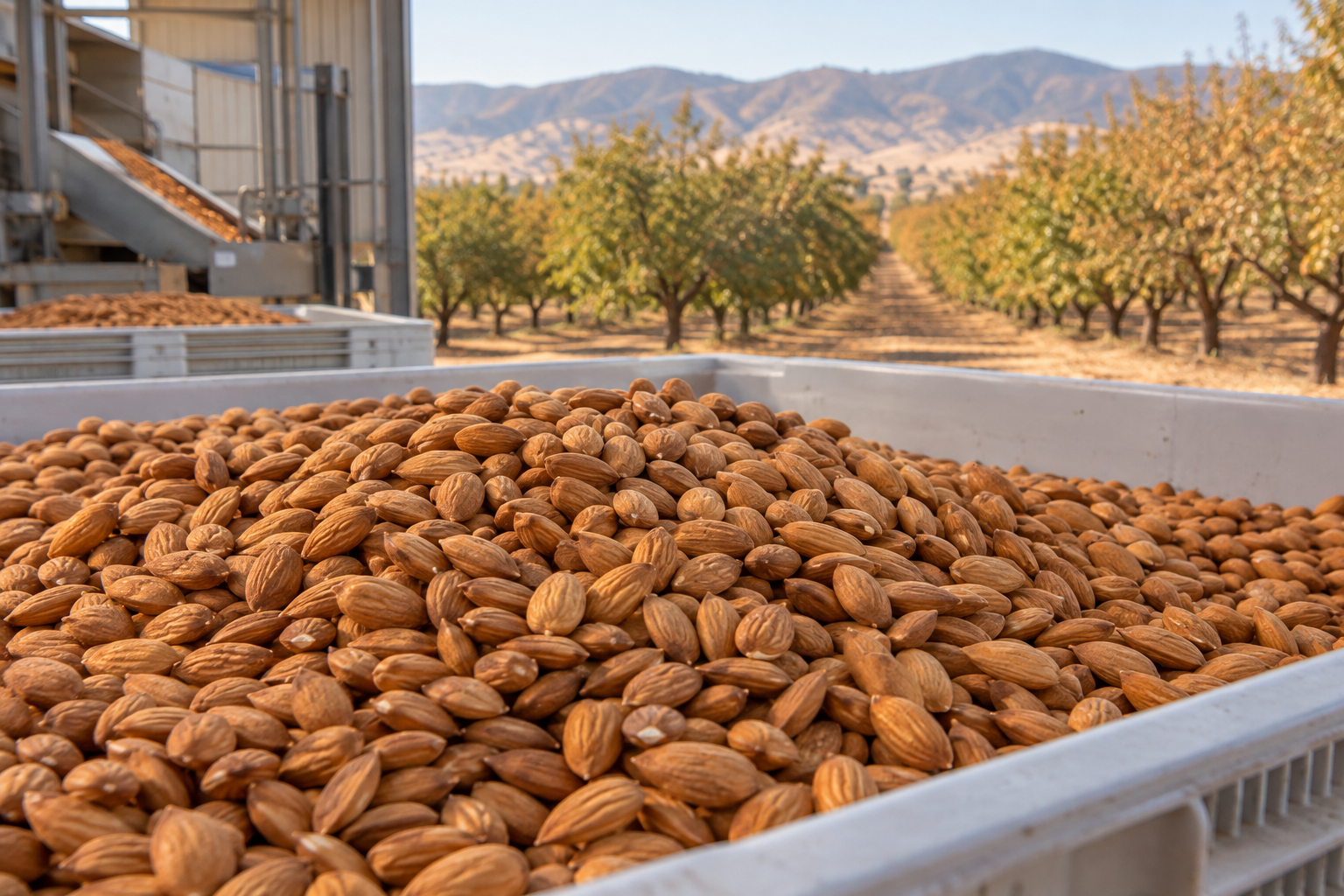
Regional market overview
North America combines a major almond production base with established processing, food manufacturing and consumer markets. California anchors commercial production, supported by orchards, hullers, shellers, handlers and ingredient manufacturers. The United States is both a producing and consuming market, while Canada and Mexico participate principally through imports, distribution, processing and food manufacturing rather than comparable orchard industries.
Almonds move through several distinct commercial channels. Whole kernels serve retail packs, snack manufacturers and confectionery businesses. Blanched, sliced, slivered and diced almonds supply bakeries and prepared-food manufacturers. Almond flour, butter, paste and beverage ingredients connect the crop to further processing markets. These uses require different specifications, so availability of almonds in general does not establish availability of a particular industrial ingredient.
The supplied AgriExchange snapshot contains 2 listed Almonds lots globally, with 0 with an asking price. It provides no North American asking-price benchmark and no basis for assessing regional transaction values. This profile therefore describes established market structures rather than current pricing or crop conditions.
Production and supply
California's Central Valley provides the core production environment, combining suitable growing conditions with irrigation and specialised orchard services. Commercial supply depends on more than harvested output: hulling, shelling, sorting, treatment, storage and packing determine when a crop becomes available in the form required by customers.
Water availability, orchard health, pollination and weather during bloom and harvest are recurring supply considerations. Their importance is structural; the supplied material does not establish how any of these factors have affected the current crop. Orchard investment and removal also operate on longer cycles than individual purchase orders, limiting the speed with which primary production can respond to changes in product demand.
Variety and kernel characteristics shape marketability. Nonpareil is widely associated with attractive appearance and uses where the whole kernel is visible. Other varieties serve whole-kernel and processing channels according to size, shape, flavour and processing performance. Variety descriptions alone are not substitutes for a complete specification.
Handlers can assemble commercial lots from orchard deliveries, making traceability and segregation important. Crop-year identity, treatment status and processing history help distinguish otherwise similar offers. Organic almonds require a separate certification and handling framework rather than simply a different product description.
Demand and trade flows
Domestic demand spans snack foods, confectionery, bakery products, cereals, foodservice and household consumption. Ingredient manufacturers also use almonds in beverages, spreads and flour-based formulations. Each channel values a different combination of appearance, flavour, texture, particle size and functional performance.
Canadian and Mexican buyers draw on United States supply through established cross-border distribution and manufacturing networks. Shipments may consist of bulk kernels for local processing or finished ingredients ready for incorporation into food products. Distributors can bridge the gap between bulk handling operations and customers requiring smaller deliveries, local warehousing or mixed ingredient orders.
California also supplies markets outside North America. Export channels connect regional handlers with overseas snack, bakery, confectionery and ingredient customers. Destination requirements can influence sorting, packaging, testing and document preparation before dispatch. Export-ready availability is therefore not necessarily interchangeable with stock prepared for domestic distribution.
Alternative nuts, seeds and other ingredients can compete with almonds in particular recipes, but substitution is constrained by flavour, labelling, allergens and manufacturing performance. The supplied information contains no almond-specific demand statistics, shipment data or consumption indicators, so it does not support a conclusion about current demand growth or contraction.
Quality, grades and compliance
Commercial specifications commonly distinguish in-shell almonds from kernels and separate natural kernels from blanched or further-processed products. Whole, broken, sliced, slivered, diced and ground forms are not directly comparable. Kernel size, defect tolerances, foreign material, insect damage and moisture condition all affect suitability for an intended application.
A grade designation needs to be read alongside the contractual specification. A confectionery customer seeking a uniform visual presentation may have different requirements from a manufacturer grinding kernels into paste. Likewise, flour and diced products require attention to particle consistency, while sliced almonds must meet expectations for thickness and breakage.
Food safety is central because almonds may be consumed without further processing that would control pathogens. California almonds supplied to the United States market are subject to an established treatment framework, with requirements and exemptions depending on the channel. Treatment documentation, supplier approval and verification remain important; a description such as natural does not, by itself, establish treatment status.
Pesticide residues, aflatoxins, sanitation and allergen controls also require attention. Regulatory limits and documentary obligations vary by destination and product form. In-shell shipments can raise different phytosanitary questions from processed kernels. Importers need destination-appropriate documentation, while organic or other certified claims require supporting records and controlled handling throughout the relevant supply chain.
Seasonality and logistics
California's almond harvest generally takes place from late summer into autumn. Mechanical shaking, orchard-floor drying, collection and movement to hullers and shellers are characteristic stages. Harvest timing varies with location, variety and weather, and harvested almonds are not immediately equivalent to packed, treated stock ready for delivery.
Stored inventory supports supply beyond the harvest period. Because almonds contain oils that can deteriorate, temperature, humidity, packaging integrity and storage duration influence quality. Protection from moisture, pests and strong odours is essential. Ground and cut products expose more surface area than intact kernels, making packaging and handling particularly relevant to shelf-life management.
Road transport links California handlers with domestic manufacturers and cross-border customers. Ocean freight connects export handlers with overseas destinations, often through West Coast gateways. Product form, shipment size, destination and delivery terms determine the practical transport arrangement.
Lead times may include sorting, blanching, treatment, testing and packing as well as transit. Container cleanliness, condensation prevention and lot identification deserve attention throughout loading and receipt. No current freight rates, port disruption reports or shipment-delay evidence are available in the supplied material.
What this means for buyers and sellers
Commercial comparisons are most useful when they concern equivalent products. Relevant details include origin, crop year, variety where applicable, grade, kernel size, processing form, treatment, certification, packaging and delivery terms. A whole natural kernel offer cannot be treated as equivalent to a blanched ingredient delivered to a factory.
For buyers, documentation helps establish whether a lot is suitable for the intended manufacturing process and destination. For sellers, clear specifications distinguish the capabilities of an available lot without relying on broad quality claims. Agreed sampling, testing, acceptance criteria and traceability support consistent communication between handlers, distributors and end users.
The platform snapshot does not establish regional stock availability, market direction or a representative price level. Any future listing with a price would represent a seller asking price, not evidence of a completed sale. The defensible regional picture is a California-centred supply chain serving diverse North American users, with commercial suitability determined by processing, quality assurance and logistics as much as by the raw kernel.
Sources
AgriExchange: supplied all-regions Almonds listing snapshot, used only for listing coverage and the absence of asking-price data. No supplied origin is identified as North American.
The supplied source headlines contain no directly relevant almond-market reporting and have not been used. Production, trade, processing and compliance descriptions reflect established structural market knowledge, not independently verified current-season developments.