
Almonds in Europe: Production, Trade and Quality Requirements
Europe combines Mediterranean almond production with imported supply and established food-processing demand. Quality specifications, traceability and delivery terms shape commercial comparisons.
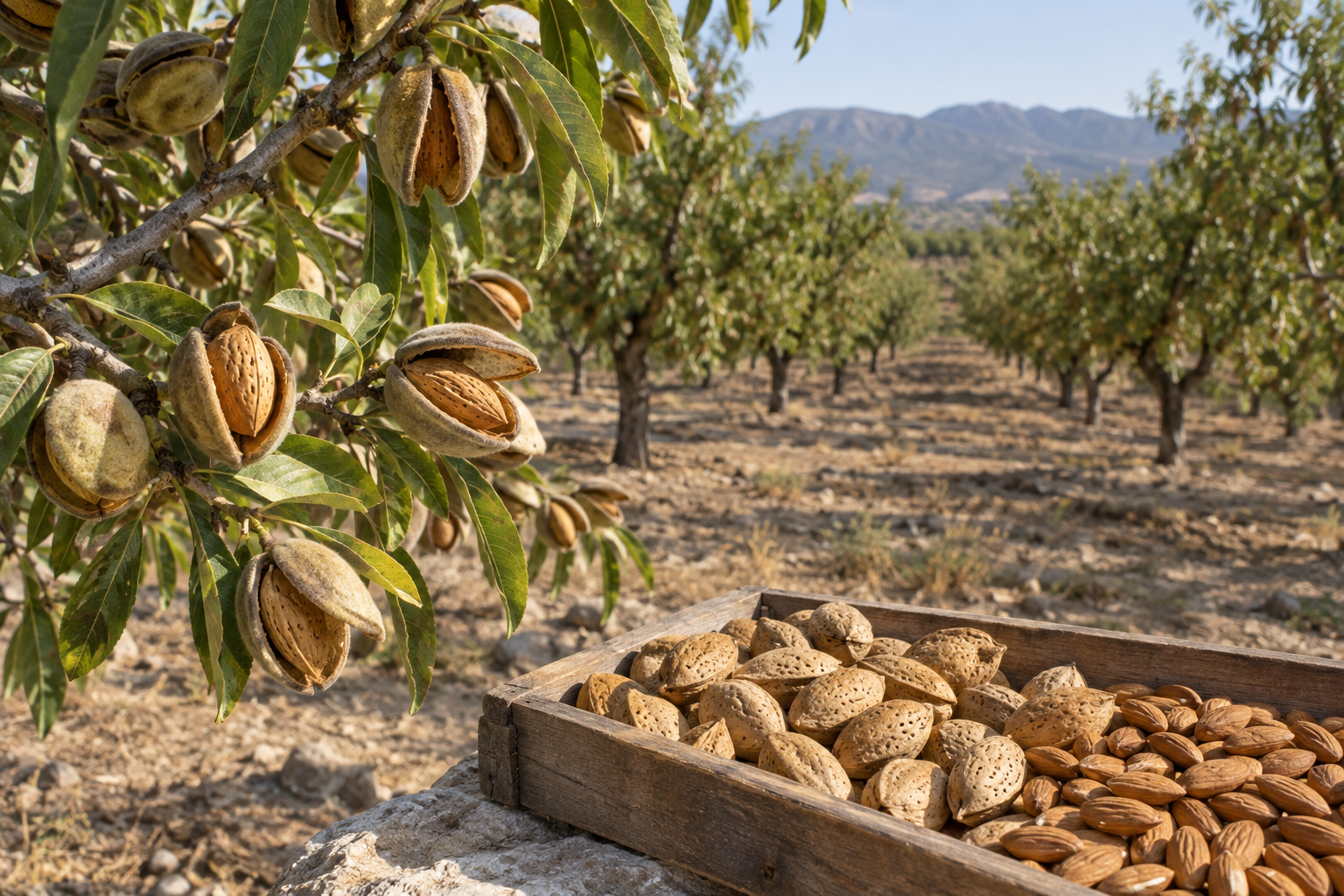
Regional market overview
Europe has an established almond market spanning Mediterranean orchards, specialist processors, food manufacturers and retail distribution. Spain, Italy, Portugal and Greece grow almonds, while consumption and processing extend across the region. Almonds serve both traditional foods and industrial ingredient applications, connecting agricultural supply with confectionery, bakery, snacks and plant-based products.
European production operates alongside imported supply, particularly from California. These sources are not interchangeable in every application: variety, kernel shape, flavour, processing suitability and origin requirements can influence purchasing specifications. A confectionery manufacturer seeking uniform kernels may assess supply differently from a producer of traditional almond sweets or a retail packer marketing regional provenance.
The supplied AgriExchange snapshot records 2 listed almond lots across all regions, with 0 carrying an asking price. It therefore provides no usable asking-price range or median and cannot establish a European market benchmark. This profile describes structural market conditions rather than verified current prices, harvest outcomes or trading activity.
Production and supply
European almond cultivation is concentrated in Mediterranean environments. Spain has an extensive production and processing sector, while Italy combines commercial cultivation with regional varieties and established food traditions. Portugal and Greece also contribute to European supply. Orchards range from traditional rain-fed plantings to irrigated systems with greater scope for mechanisation.
These production systems have different supply characteristics. Rain-fed orchards depend heavily on seasonal rainfall and stored soil moisture. Irrigated orchards remain exposed to water availability and management constraints. Almond trees flower early, making frost during flowering a structural production risk. Conditions affecting pollination, kernel development and harvest can also influence marketable quality.
After harvest, almonds move through hulling, drying, shelling, sorting and, where required, further processing. Supply can be offered in-shell, as natural kernels, or as blanched, sliced, slivered, diced and ground ingredients. Shelling yield and processing losses matter when comparing raw material costs across these forms.
Imported kernels complement European crops by broadening the available range of sizes, specifications and processing characteristics. California is an established external source, while Australian supply can also enter European channels. Availability for a particular customer depends on the contracted specification, stock position and processing capacity, rather than origin alone.
Demand and trade flows
Demand is spread across household consumption and manufacturing. Retail channels handle natural and roasted almonds, snack mixes and baking ingredients. Industrial users include chocolate and confectionery producers, biscuit manufacturers, bakeries, marzipan processors and producers of almond-based drinks. Foodservice and specialist pastry businesses add demand for whole kernels and prepared ingredients.
Spain and Italy combine domestic production with processing and consumption. Germany and France have established confectionery, bakery and retail markets, while the Netherlands serves as a trading and distribution location for imported food ingredients. The United Kingdom is another destination for retail nuts and manufactured almond products.
Trade flows therefore extend beyond direct movements from an orchard's country to the final consumer. Imported almonds may enter through a European port, undergo storage or processing, and then move to manufacturers elsewhere in the region. European-grown almonds likewise move across borders for shelling, packing or ingredient manufacture.
Commercial comparisons require a consistent basis. Natural kernels, blanched kernels and almond flour represent different processing commitments. Delivery location, freight, insurance, customs treatment, packaging and payment terms can also change the meaning of an offer. No price comparison is supported by the supplied platform data.
Quality, grades and compliance
Quality specifications commonly address variety, kernel size, whole-kernel proportion, broken material, foreign matter, moisture, insect damage and sensory condition. Uniformity is particularly relevant where almonds remain visible in finished products. For grinding or paste manufacture, flavour, composition and processing performance may matter more than appearance, although food-safety requirements remain essential.
Natural and blanched almonds need separate assessment. Blanching removes the skin and changes the product's appearance and application. Sliced and slivered products require attention to thickness and breakage, while ground almonds need an agreed particle profile. Differences in raw material and processing can affect performance even where product descriptions appear similar.
Food-safety controls include attention to aflatoxins, pesticide residues, microbiological hazards and contamination during storage or processing. Salmonella is a relevant hazard for low-moisture foods, including nuts; low moisture does not itself establish microbiological safety. Treatment records, sampling arrangements and laboratory documentation can therefore form part of customer approval procedures.
Almonds are subject to allergen declaration requirements. Traceability should connect the supplied lot with its origin, processing history and dispatch documentation. Organic claims require appropriate certification and chain-of-custody evidence. European Union requirements and those of other European destinations are not automatically identical; applicable food-safety, labelling, customs and plant-health obligations depend on the destination and product form.
Seasonality and logistics
Mediterranean almond harvesting generally falls in late summer and early autumn, with timing varying by location, variety and weather. California's harvest occupies a broadly similar seasonal window, whereas Australia's southern hemisphere cycle differs. Stored inventories and processing schedules allow trade to continue beyond harvest periods.
New-crop availability does not necessarily mean immediate availability of every finished specification. Drying, shelling, sorting, testing and packing intervene between orchard collection and dispatch. Blanching or cutting adds further scheduling requirements. Crop year, processing date and dispatch readiness are therefore distinct pieces of commercial information.
Almonds require dry, clean storage and protection from pests, moisture uptake and strong odours. Their oil content makes oxidation and rancidity important shelf-life considerations. Packaging integrity, storage temperature and exposure to air affect condition, particularly for processed forms with greater exposed surface area.
Imported supply commonly combines ocean freight with onward road distribution. Within Europe, road transport links growing areas, processors, warehouses and manufacturing sites. Shipment documentation, container condition and handling practices all influence delivery quality. The supplied information does not establish current freight conditions, port delays or warehouse availability.
What this means for buyers and sellers
The central commercial issue is specification alignment rather than a single regional almond price. Origin, variety, form, size, treatment, crop year and delivery basis determine whether offers address the same requirement. A quotation without those details provides limited evidence of relative value.
For buyers, supplier qualification connects product performance with traceability and food-safety assurance. For sellers, clear lot descriptions and supporting documentation help distinguish available material from a generic almond listing. Neither side can infer European price levels or market direction from the unpriced platform snapshot.
Europe's almond market combines local provenance, imported supply and specialised processing demand. Understanding those relationships helps explain trade patterns without assuming that every almond lot serves the same customer or application.
Sources
AgriExchange supplied platform data: all-region almond listing counts and asking-price availability. These are listing observations, not completed sales, and do not provide a European price series.
The supplied source headlines contain no almond-specific European market evidence and have not been used. Production, trade, seasonality and quality discussion reflects established structural market knowledge, not independently verified current-season developments.