
Almonds in Africa: Regional Supply, Demand and Trade Profile
Africa’s almond market combines North African cultivation with import-led demand elsewhere. Product form, food safety and inland distribution shape trade, while platform pricing is unavailable.
Regional market overview
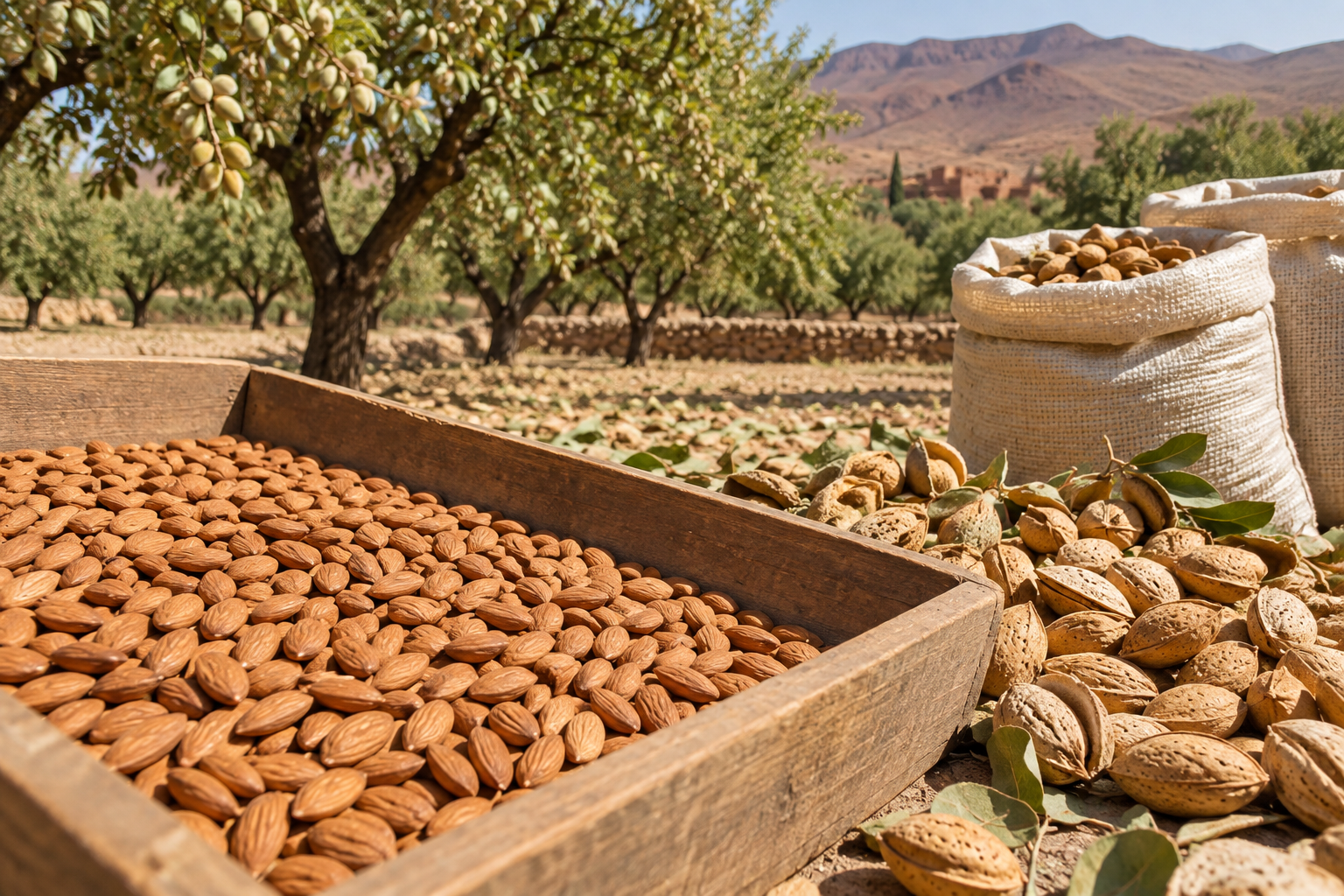
Africa’s almond market connects established cultivation and culinary traditions in North Africa with import-dependent consumer and processing markets elsewhere on the continent. Morocco, Tunisia and Algeria grow almonds, while South Africa also has commercial cultivation. Conditions differ substantially between producing districts, so Africa is better understood as a collection of national and local markets than as a unified almond supply basin.
Demand spans traditional confectionery, bakery ingredients, packaged snacks, hospitality and food manufacturing. Almonds reach these users as in-shell nuts, natural kernels, blanched kernels and prepared ingredients. Their role varies by market: local harvests have particular relevance in North African food traditions, while imported, consistently specified kernels serve formal retail and industrial customers across several African economies.
The supplied AgriExchange snapshot contains 2 listed Almonds lots across all regions, with 0 with an asking price. It therefore provides no numerical basis for a regional price comparison. Bobo-Dioulasso, Burkina Faso is the African location in the listed-origin field; that entry alone does not establish where the almonds were grown or demonstrate a local production industry.
Production and supply
North African almond production benefits from Mediterranean growing conditions, with cool winters and hot, generally dry summers. Orchards range from traditional rain-fed plantings to more intensively managed systems. Water availability, flowering conditions, pollination and orchard management influence crop performance. Almond trees flower relatively early, making frost during bloom a structural production risk in susceptible locations.
Morocco, Tunisia and Algeria supply domestic markets through networks that can include growers, collectors, shellers, wholesalers and food processors. The balance between local production and imported material differs by country and product specification. A locally available in-shell almond is not necessarily a direct substitute for a uniform, blanched ingredient required by an industrial bakery.
Commercial cultivation in South Africa adds another supply base, with a Southern Hemisphere production calendar. Even where almonds are grown domestically, imported kernels can complement local output by providing particular varieties, size grades or processing formats. Cultivation and importing are therefore not mutually exclusive features of a national market.
Supply availability also depends on processing capacity. Hulling, shelling, drying, sorting and suitable storage determine whether harvested almonds become usable commercial lots. Kernel recovery, shell hardness and the proportion of damaged material affect processing economics. These characteristics help explain why comparisons based solely on an in-shell lot’s weight can misrepresent its value relative to shelled kernels.
Demand and trade flows
North African demand includes almonds used in pastries, confectionery and household cooking, alongside packaged snack consumption. Celebrations and religious festivals can concentrate purchasing for traditional foods, although the timing and strength of this effect vary by country and customer group. Bakers and confectioners may require whole kernels for presentation, while paste and filling manufacturers can use suitable broken material.
Egypt and South Africa are important markets to consider for imported nuts and processed food ingredients. Elsewhere, urban retailers, hotels, restaurants and specialist wholesalers provide channels for almonds, with demand shaped by household purchasing power and the reach of organised distribution. These channels should not be treated as evidence of equally broad consumption across the continent.
African importers can source almonds from established international exporting countries, including the United States, Spain and Australia. Product may arrive directly from an exporter or through an intermediary trading and distribution hub. The commercial chain can include local roasting, seasoning, repacking or further ingredient preparation before the almonds reach consumers.
Trade comparisons depend on what is actually being supplied. Natural kernels, blanched slices, almond flour and roasted retail packs carry different processing, packaging and handling requirements. Freight terms, customs charges and inland delivery also affect landed cost. The supplied platform snapshot does not disclose enough information to compare those costs or establish a prevailing African almond price.
Quality, grades and compliance
Almond specifications typically cover product form, variety where relevant, kernel size, uniformity, moisture, defects and foreign material. Whole-kernel appearance matters for snack packs and decorative bakery uses. For flour, paste and fillings, functional performance and flavour may matter more than appearance, but food safety requirements remain equally important.
Commercial sweet almonds need to be distinguished from bitter almonds and other kernels that may resemble them. Product identity, traceability and accurate descriptions are consequently important, especially where lots pass through several intermediaries. A location recorded in a marketplace listing is not a substitute for documented country of cultivation or processing history.
Quality risks include insect infestation, mould, rancidity and contamination during handling. Aflatoxin controls, pesticide residue compliance and microbiological requirements can be relevant to almond trade. The applicable limits and documentation depend on the destination and intended use; there is no single continent-wide specification that can safely be assumed for every shipment.
Depending on destination rules and product form, trade documentation may include phytosanitary certification, origin documentation, laboratory results and food safety records. Processed and retail-packed products also face relevant labelling and allergen requirements. Roasting or blanching does not remove the need for traceability, hygienic handling and appropriate storage after processing.
Seasonality and logistics
North African almond harvesting generally falls in late summer and early autumn, with local timing determined by variety, elevation and weather. South African harvesting occurs during the Southern Hemisphere late summer and autumn. International sourcing can broaden availability beyond domestic harvest periods, while stored kernels support year-round processing and retail demand.
Harvest timing alone does not determine when a commercially usable lot becomes available. Drying, shelling, grading, testing and packing can separate orchard harvest from dispatch. Freshly harvested material and older inventory may also differ in remaining shelf life, making production and packing information relevant to stock management.
Almonds require protection from moisture, excessive heat, pests and strong odours. Sea freight and inland transport can expose cargo to temperature changes and condensation, especially where packaging or container condition is unsuitable. Dry storage, sound packaging and controlled handling help preserve quality through the distribution chain.
Landlocked destinations face additional inland movements after discharge at a coastal port. Border procedures, warehouse transfers and road transport introduce handling stages beyond the ocean shipment. For any listing associated with Bobo-Dioulasso, the dispatch location, actual stock position and delivery terms would determine the relevant logistics rather than the origin-field label alone.
What this means for buyers and sellers
The main commercial distinction is between an available almond lot and a lot that matches a defined use. Product identity, form, size, condition, documentation and delivery basis determine comparability. Industrial customers place particular weight on consistency and processing performance, while wholesalers and retailers also consider presentation, pack format and shelf life.
For suppliers, clear specifications and traceable documentation support meaningful assessment of an offer. For customers, those details explain differences that a headline quotation cannot capture. With no asking prices in the supplied snapshot, neither a regional price benchmark nor a transaction-price conclusion is supported. This profile describes market structure rather than current harvest performance, stock levels or trading activity.
Sources
AgriExchange supplied platform data: all-region Almonds listing counts, asking-price availability and the African location recorded in the listed-origin field. Marketplace asking prices, when available, are seller quotations rather than completed sales. None are available here. The supplied news headlines do not provide almond-specific African market evidence and have not been used. The remaining discussion reflects established qualitative market and supply-chain characteristics.